Finding the Perfect Entry on Meme Coin Charts
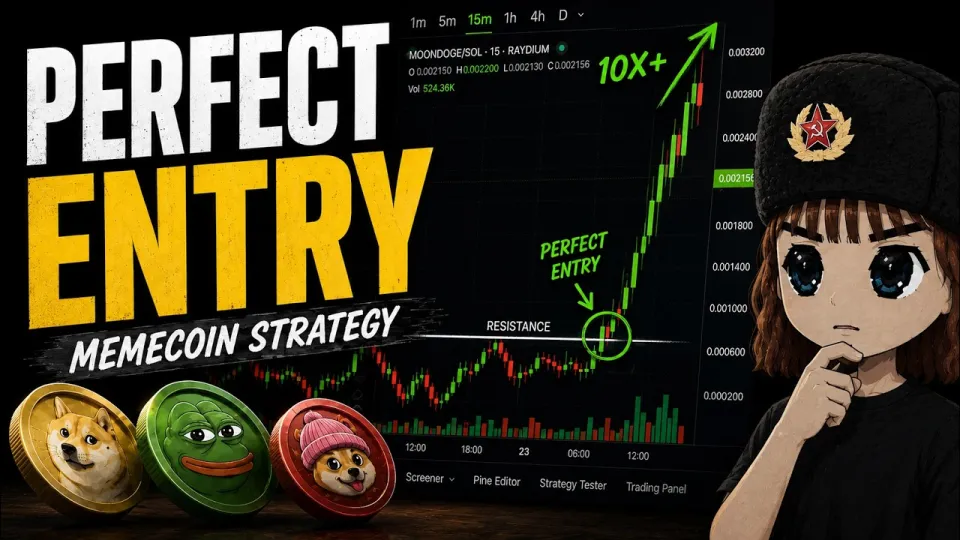
Video: How I Find the PERFECT Entry on Memecoins 📈 (Full Strategy)
Need articles like this for your video? They help promote it on YouTube and Google — order them in the Telegram bot @sat_sit_bot. Articles with your video embedded are written and posted by the bot itself — on popular topical sites (no ads). Your first 50 articles are free.
· based on the channel starwifpump
Meme coin trading is mostly a timing problem: the same token can be a great trade or a total loss depending on where you enter. A high-quality entry means buying after momentum is confirmed, on a pullback or at a support level, with a predefined level that proves the idea wrong and a risk plan written before the order. That is the framework the starwifpump breakdown builds on, and the same logic applies whether you trade Solana launches or tokens on other chains — the tooling the channel points to for early access is available through the Plasma Telegram group.
Why entry timing decides meme coin outcomes
Selection gets all the attention, but entry price sets the entire risk-to-reward profile of a position. Two traders can buy the same token on the same day: one enters after a 40% extension on a green candle and needs another leg up just to break even, the other buys the retest of the breakout level and is in profit while the first is still underwater. Meme coins amplify this because liquidity is thin and moves are fast — a token can retrace half its run in minutes, and the difference between entering at the top of an impulse and entering on the pullback is often the difference between a 1:1 and a 1:4 setup.
The practical consequence is that you should stop asking "which coin?" first and start asking "where is my entry, and what would make me wrong?" A mediocre token bought well frequently beats a hyped token bought badly.
The three conditions of a valid setup
A tradable entry needs momentum, a reference level and an invalidation point — all three, not two. Momentum tells you the market is actually interested; the reference level (support, a prior consolidation, a retested breakout) tells you where your risk is defined; the invalidation point tells you when to walk away without arguing with the chart.
- Momentum confirmed, not assumed. Volume and higher highs on the chart, not a green candle you happened to notice. If the move is already extended vertically, you are late, and late entries carry the worst risk-to-reward.
- A level to lean on. Pullbacks into support, a retest of the level that broke, or a tight consolidation after an impulse. Buying into empty space gives you no reference for a stop.
- A clear invalidation. A lower low, a lost support, a failed retest. If you cannot name the price where your thesis dies, you do not have a setup — you have a hope.
How to read momentum without chasing the pump
Momentum is information about participation; the pump candle itself is usually the worst place to act on it. The useful sequence is impulse, pause, and continuation: a strong move up, a period where sellers test the move and fail, then a break higher. Entering during the pause or on the confirmation of the continuation keeps you close to your invalidation level, while entering mid-candle puts your stop far below and your entry far above the structure.
Practical markers traders watch on meme coin charts:
- Volume expanding on the impulse and contracting during the pullback — that is a healthy pause, not distribution.
- Higher lows holding on successively smaller retraces.
- The first pullback after a breakout being bought aggressively, which is often the cleanest entry of the whole move.
- A vertical run with no pause at all, which is a signal to wait, not to chase.
Pullbacks, support and the levels that matter
Support on meme coins is where previous buyers proved they would defend price — prior consolidation ranges, the breakout level, and the base of the last impulse. The most repeatable entry pattern is the retest: price breaks a range, pulls back into the top of that range, holds, and turns up. Your stop sits just below the level, which makes the trade cheap to be wrong on.
Two rules keep this honest. First, the deeper the pullback relative to the impulse, the weaker the structure — a retrace that erases most of the move is a warning, not a discount. Second, a level that gets tested repeatedly in a short window is being consumed; the third or fourth tap of the same support is not the same trade as the first.
Signals that tell you not to enter
The most valuable chart skill is knowing when to stand aside. Skip the trade when:
- Price is already extended far from any structure, so your stop would be unreasonably wide.
- Volume fades while price grinds higher — a move without participation.
- The chart prints a lower high after a failed breakout, which flips the structure bearish.
- The only reason to buy is that everyone else is talking about it. FOMO is a position-sizing error disguised as conviction.
- You cannot state your exit before entering. No plan, no trade.
Planning risk, exits and profit-taking before entry
Risk planning happens on paper, not in the moment. Decide the position size from the distance to your invalidation level, so that being wrong costs a fixed, small percentage of your account regardless of how volatile the token is. Then set the plan in advance: take partial profit into the first obvious resistance or round-number level, move risk to breakeven only after the market has actually confirmed the move, and let a runner ride only with money you have already mentally written off.
Meme coins can go to zero, so treat every position as capable of doing exactly that. A repeatable process — fixed risk per trade, defined invalidation, pre-planned exits — is what separates trading from gambling, and it is the part of the strategy that survives when a narrative dies.
Common questions from newer traders
Beginners tend to ask the same things: how to filter the endless stream of new launches, whether the same approach works on every chain, and how to check social signals like tweets that might trigger a pump. The honest answers: filters and trackers narrow the universe but never replace chart reading; the entry logic (momentum, retest, invalidation) transfers across chains, though liquidity and launch mechanics differ; and social momentum is a context input, not an entry trigger on its own. Several viewers also mention losing money early and wanting to return with a smaller bankroll — that is exactly when fixed risk per trade and a written plan matter most.
Useful links
- Plasma Telegram — early access, updates and setup help
- Discord community
- Padre terminal VIP access
- Solpump
- starwifpump on X
Building a repeatable entry process
Entry quality is a skill you can systemise: wait for confirmed momentum, buy the pullback into a real level, define the price that proves you wrong, size the position from that distance, and take profit on a plan written before the trade. None of this predicts every move — it simply removes the emotional decisions that turn a good coin into a bad trade. The full strategy breakdown comes from the starwifpump channel, which focuses specifically on meme coin chart analysis and entry timing rather than narratives alone. If you want the toolkit side of it — paper trading, sniping, copy trading and position tracking in one place — start with the Plasma Telegram for early access. Meme coins remain highly volatile and this material is educational only, not financial advice.
Key takeaways
- Most meme coin losses come from bad timing, not bad coin selection — entry price determines the risk-to-reward of the whole trade.
- A quality setup needs three things: confirmed momentum, a pullback or support level to enter against, and a clear level that invalidates the idea.
- Chasing green candles and buying on FOMO is the most common way traders turn a good narrative into a losing position.
- Risk, exit targets and profit-taking should be planned before the entry, not after the price starts moving.
- Tools like Plasma (early access via the channel's Telegram) bundle paper trading, sniping, copy trading and position tracking in one terminal.
Source: How I Find the PERFECT Entry on Memecoins 📈 (Full Strategy) · Markdown version
Questions & answers
What counts as a good entry on a meme coin?
A good entry combines confirmed momentum, a reference level such as a pullback or retested support, and a clear invalidation point below the structure. If your stop would be unreasonably far away or you cannot name the price that proves you wrong, the entry is not good regardless of how strong the narrative looks.
How do I avoid chasing a pump?
Wait for the pause rather than the vertical candle. Entering on the first pullback that holds support, or on confirmation of a continuation after consolidation, keeps your entry close to your invalidation level. Buying mid-impulse pushes your stop far below and destroys the risk-to-reward of the trade.
Does this entry approach work on chains other than Solana?
The core logic — momentum, retest, invalidation, fixed risk — transfers to any chain because it is about chart structure. What changes is liquidity depth, launch mechanics and how fast tokens can rug, so position sizing and slippage assumptions need adjusting per chain.
Should I use trackers and social signals to find entries?
Trackers and social monitoring help narrow the universe of tokens worth charting, but they are context rather than triggers. A tweet or a trending feed can start a move; your entry still has to come from structure on the chart and a predefined risk plan.